
Our struggles are interconnected
Having tough conversations with friends and virtual events to join

Are you enjoying your Fembot weekly newsletter? Please consider forwarding this e-mail to a friend and having them subscribe.
Interested in upcoming feminist virtual events concerning what is happening in the news? We suggest you consider attending the Parent Wound webinar to dive into how colonization impacts us led by Dr. Jennifer Mullan. There’s also a virtual event called Black Feminist Writers and Palestine. This online event will focus on the importance of the Black feminist literary and political canon and the mandate of Black feminist commitments to a free Palestine.
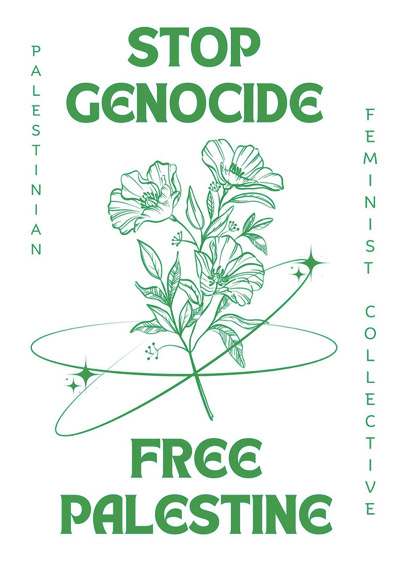
Looking for ways to donate? The Palestinian Feminist Collective is gathering donations. Image below is a print by Mimi Thi Nguyen and Eman Ghanayem for Palestinian Feminist Collective.
Ten years had passed since I last saw my dear friend, Sarah. Life had taken us on different journeys, across miles and through countless changes. But, there was something that drew us together in the first place, something stronger than the passing of time. It was our shared values as writers, our passion for justice and feminism, and our desire to make the world a better place, qualities that had initially connected us when we crossed paths in our high school newspaper class, where I served as the editor in chief as a senior and she was a freshman. It was 10 years since we last saw each other.
Our reunion was long overdue, and when it finally happened, it was filled with gossiping about our classmates, our careers, and what we’ve been up to. However, as the evening progressed, we couldn't ignore the elephant in the room - the ongoing Palestinian genocide. Sarah is Palestinian, and her connection to the current Palestinian genocide is deeply personal. She shared stories of her family's experiences, the struggles they've faced, and their determination to hold onto their homeland. Her family, like my own, had endured the trauma of displacement and the loss of loved ones. As we talked, it became evident that the pain of the past generations was a constant presence in her life.
On the other side of the conversation, I am Armenian, the great-granddaughter of an Armenian genocide survivor. Our struggles and stories are interconnected. The stories of my great-grandparents were a haunting presence in my family's history, much like Sarah's experiences. The horrors they had faced during the 1915 Armenian genocide and what has currently happened as indigenous Armenians were forced out of their land had been a warning sign passed down through generations. The pain of losing family members, the suffering as refugees, and the resilience of those who survived were part of my family's collective memory.
Our personal backgrounds provided a unique backdrop for the conversation, highlighting the importance of addressing and understanding such complex issues, especially when it relates to ongoing conflicts and human rights violations. It made our conversation all the more crucial, as we recognized the significance of our voices in advocating for justice and peace.
Our conversation was emotionally charged but respectful. We didn't convince each other to change our opinions, but we left with a deepened respect for the complexity of the issue and for each other's perspectives. Most importantly, we left with the understanding that this was an ongoing conversation, one that would continue to evolve as we learned more, grew, and engaged in open dialogue with others.
Meeting with Sarah after a decade and having a difficult conversation about the Palestinian genocide taught me that maintaining authentic connections with people means embracing tough topics, especially when they concern human rights and justice. It reaffirmed that we can agree to disagree, and that dialogue, even when challenging, is a powerful tool for growth and understanding. Our identities, shaped by historical traumas, emphasized the importance of empathy and open dialogue, and our meeting after a decade only strengthened our resolve to continue these conversations and work towards a more just and peaceful future for all.
Navigating tough conversations about sensitive topics, such as conflicts, genocides, or human rights abuses, with friends can be challenging but also highly important. Here's a guide on how to approach these discussions:
1. Choose the Right Time and Place:
Find a comfortable and private setting where both you and your friend can speak openly without distractions. Timing is crucial; don't bring up difficult topics during emotionally charged moments or busy, stressful periods in your lives.
2. Do Your Homework:
Before you initiate the conversation, gather relevant facts, statistics, and information about the issue. Understanding the context and complexities will help you present a more informed perspective.
3. Express Your Concerns:
Start by sharing your genuine concern about the issue. Use "I" statements to convey your feelings without placing blame. For example, say, "I am deeply concerned about the situation in [region] because..."
4. Listen Actively:
Give your friend the opportunity to express their thoughts and feelings. Show empathy by actively listening and refraining from interrupting. Ask open-ended questions to encourage them to share their perspective.
5. Find Common Ground:
Identify shared values and concerns. Highlighting areas of agreement can be a powerful way to build bridges and reduce tension. Recognize that both of you likely want a peaceful and just resolution to the conflict.
6. Respect Differences:
It's essential to acknowledge that you and your friend may have differing views. Respect these differences and avoid pushing your beliefs onto them. A mutual understanding of each other's perspectives is more important than agreement.
7. Avoid Blame and Accusations:
Stay away from blaming or accusing language. Focus on discussing the situation and its impacts rather than pointing fingers. Remember, the goal is not to win an argument but to engage in a meaningful conversation.
8. Use "I" Statements:
Share your perspective using "I" statements. For instance, say, "I feel that the humanitarian situation in [region] needs international attention," rather than making accusatory statements like, "You need to understand that..."
9. Be Mindful of Emotions:
Emotions can run high during these discussions. Be aware of your emotional state and encourage your friend to do the same. If the conversation becomes too heated, take a break and return to it later when both of you are calmer.
10. Agree to Disagree:
It's entirely possible that you and your friend won't reach a consensus. In such cases, agree to disagree, but reaffirm your commitment to open dialogue and a willingness to revisit the topic in the future.
11. Suggest Further Research:
If your friend expresses a desire to learn more or understand the issue better, suggest books, documentaries, or articles that provide various perspectives. Encouraging them to research can lead to more informed discussions.
12. Maintain the Friendship:
Remember that the friendship is more valuable than the disagreement. Ensure your friend knows that your relationship goes beyond this one topic and that your bond remains intact.
Navigating tough conversations with friends about sensitive and complex issues requires empathy, patience, and a willingness to engage in open and respectful dialogue. While it may not always lead to full agreement, these discussions can foster mutual understanding and strengthen your friendship.

